
What a T-Shirt Made Possible: Why Being Visible Matters
By Jasmin Faulk, WoLF Executive Director
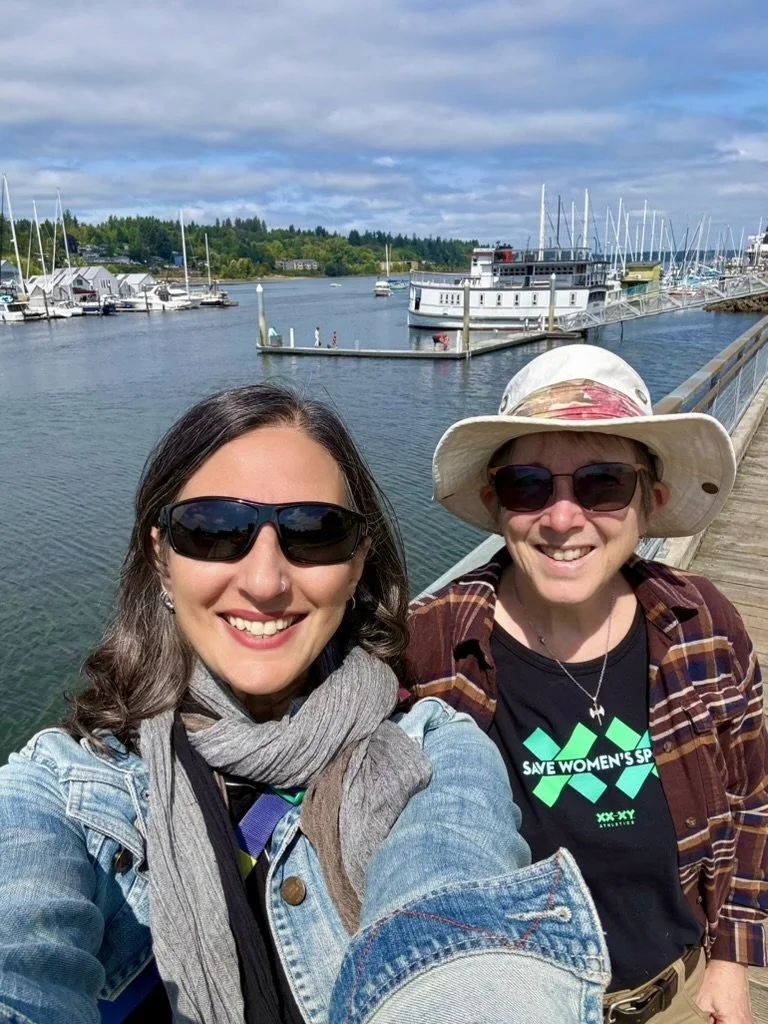
This past weekend, I had the wonderful opportunity to visit with one of WoLF’s dedicated volunteers—and one of our very special sisters—Joni Zander at a local farmers market.
Because we both live in the Pacific Northwest, Joni and I understand the challenges faced by women who speak openly about sex-based rights in this part of the country. Many of us come from progressive/liberal backgrounds and have spent
our lives supporting women’s rights, gay and lesbian rights, fairness, and equality. Yet we have watched the culture around us become increasingly intolerant of honest disagreement.
For some, simply saying that women are a distinct sex class—or that girls deserve fair athletic competition—has come at a real cost. Friendships have ended. Professional relationships have been damaged. Entire communities have turned their backs on women who refused to abandon what they knew to be true.
So, when Joni arrived at the market wearing a shirt from XX-XY Athletics, I was immediately filled with pride.
“You are brave,” I told her. “Walking through a farmers market in Olympia wearing that shirt?”
She laughed. “Brave—or just not very smart?”
We both knew what she meant. The exchange was lighthearted, but the concern behind it was real. We fully expected that someone might see the shirt, take offense, and decide to confront her. As we walked through the market, however, nothing happened.
Then, just a few minutes before we were preparing to say goodbye, everything changed.
We had stopped at a produce stand to buy zucchini and fruit when a mother and her teenage daughter approached Joni. I was standing on the other side of the counter and could not hear their conversation. When I walked back over, Joni was beaming.
“They recognized my shirt,” she told me. “They thanked me for supporting girls’ sports.”
I could not let them leave without speaking to them.
“Excuse me,” I said as I approached them. “I heard that you recognized Joni’s XX-XY shirt?”
They both looked at me cautiously.
“Um…yes,” the young girl replied.
I immediately understood their hesitation. They thought I might be approaching to criticize them.
“No—I want to thank you,” I said. “I appreciate that you said something. I know that may not always feel easy here.”
Their expressions changed instantly. The tension disappeared, and what followed was a warm, honest, enthusiastic conversation among four women who had found one another unexpectedly in the middle of a crowded market.
The daughter was a high school athlete. She recognized the shirt because she and her mom follow Jennifer Sey, the founder and CEO of XX-XY Athletics and a prominent public voice in support of female athletes.
The young woman told us she believes she may be expected to compete against a trans-identified male in track and field next year. She also shared that several of her friends have already lost races to male competitors participating in girls’ events.
This was not a theoretical discussion for her. It was her school, her sport, her friends, and potentially her own opportunity to compete fairly. She understood exactly what was at stake.
Joni and I assured her that her voice matters. Most importantly, she is not alone.
We told the mother and daughter about WoLF and about the many organizations and individuals working to protect the rights, safety, and opportunities of women and girls. They were thrilled to learn that there were places where they could find information, support, and connection.
The entire conversation lasted only about ten minutes. Yet I thought about it for the rest of the day.
Why did this brief encounter matter so much?
It mattered because public silence can create a false impression. When people are afraid to speak, each person begins to believe she is standing alone. A room—or a farmers market—may be filled with people who quietly agree, yet no one knows it because everyone is waiting for someone else to speak first.
That day, Joni spoke without saying a word. Her shirt was enough.
Her willingness to wear a visible message gave a mother and daughter the confidence to approach her. Their willingness to offer a few words of support opened the door to a meaningful conversation. That conversation allowed a young athlete to leave knowing that adults were willing to stand beside her.
One person’s confidence gave another person permission to be confident too.
That is how fear begins to lose its power.
For years, many women have carefully measured every word, wondering whether honesty might cost them a friendship, a job, or their place in a community. Some have chosen silence for understandable reasons. Others have spoken and paid a painful price.
Many of us know what it feels like to lose people we loved simply because we would not deny reality or surrender women’s rights. Those losses are real, and we should not minimize them. But neither should we allow them to convince us that we are isolated.
We are not isolated. We are finding one another—in courtrooms, in schools, at public meetings, online, and sometimes beside a produce stand at a farmers market.
I went home that afternoon feeling invigorated and deeply encouraged. Not because we had won an argument or confronted an opponent. Nothing dramatic happened. What moved me was precisely how ordinary and human the encounter was. I felt an immense sense of pride and urgency, and understood fully that losing my job just months earlier for speaking on behalf of women had landed me exactly where I needed to be—doing the work of my life’s purpose.
Four women talked openly. A mother supported her daughter. A young athlete shared what she was facing. Two women she had never met listened to her and assured her that her concerns mattered and that we were at the forefront of that work.
That should not require courage. But when it does, courage deserves to be acknowledged.
This encounter also reminded me why WoLF’s work is so important. Our legal cases, public education, advocacy, and outreach are ultimately about real women and girls—people who deserve to know that their rights will not be quietly surrendered and that someone is prepared to defend them.
Young female athletes should not be left to carry this burden by themselves. They should not have to choose between remaining silent and risking condemnation from their peers and communities. They need adults who are willing to tell the truth clearly, calmly, and without apology.
They need us to be visible.
We do not have to be loud or confrontational to make a difference. Sometimes change begins with a shirt, a conversation, or a simple “thank you.” It begins when we stop assuming that everyone around us disagrees and start recognizing how many people have simply been waiting to know they are not alone.
Joni wore the shirt. A mother and daughter spoke. Four women connected.
And a young girl went home knowing that there are people standing with her.
So did I.
I went home with a renewed sense of purpose—and with the certainty that none of us is as alone as we may sometimes feel. Every time one person speaks honestly, another finds the confidence to do the same. We are finding one another: women standing together, men and fathers standing beside us, and public servants willing to defend our rights. That collective resolve is our strength, and it makes one thing clear: the rights of women and girls are not negotiable.