
Thank You, Sophie: How One Woman’s Courage Became a Rallying Cry
By Jasmin Faulk, WoLF Executive Director
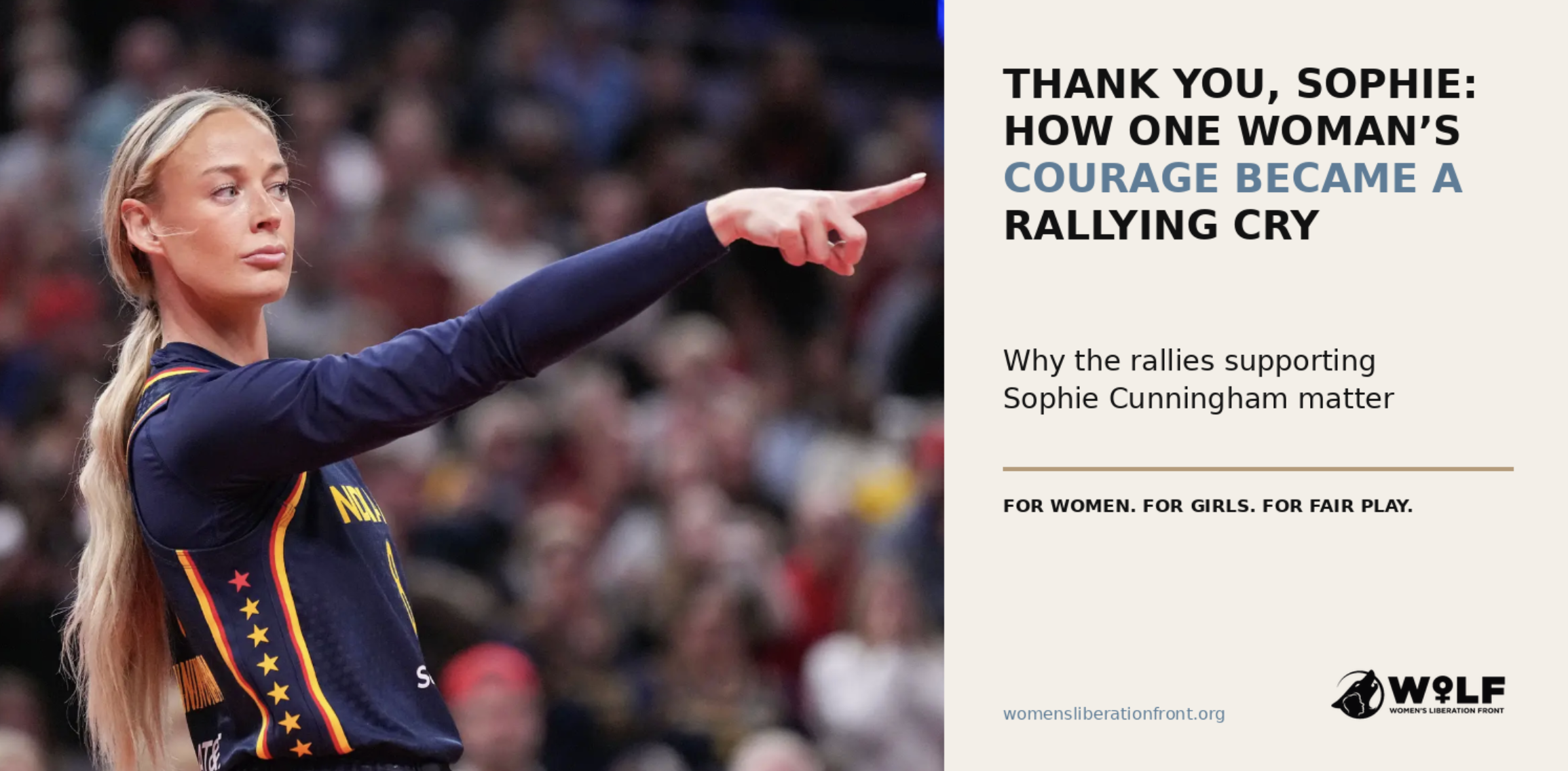
In recent days, women and girls have gathered outside Indiana Fever games in Seattle, Portland, Minneapolis, and Chicago carrying signs that say, “Thank you, Sophie.” They have come to support Fever guard Sophie Cunningham after she spoke publicly in defense of keeping women’s sports female. Some have carried her number. Teenage girls have held signs of their own. Together, they have stood visibly, peacefully, and without apology.
These gatherings matter. Not because they are against anyone, but because they are unmistakably for women and girls.
That distinction is not a slogan or a public-relations strategy. It is the heart of the issue.
Supporting female sports is not exclusion for exclusion’s sake. Athletic categories exist to create meaningful competition. We organize sports by age, weight, ability, and sex because physical differences matter. The female category was created so women and girls could compete fairly, earn recognition, develop their abilities, and experience the dignity of an arena in which their bodies are not treated as a disadvantage they must somehow overcome.
To defend that category is not to deny anyone’s humanity. It is to acknowledge women’s physical reality and insist that our rights, boundaries, and opportunities matter too.
What Girls Learn When We Defend Their Sports
For a young girl, sports are about far more than a score, a medal, or a trophy.
On a court, field, track, or mat, she learns that her body is capable—not something to be judged or disrespected. She learns discipline, courage, teamwork, resilience, and the confidence to occupy space without unwanted attention. She learns how to lose without surrendering and how to win without shrinking. The Women’s Sports Foundation reports that girls who participate in sports experience higher confidence and self-esteem, a more positive body image, and greater psychological well-being. Isn’t that what we want for all girls? Imagine the women they will become if they grow up with these opportunities.
Those lessons follow girls into classrooms, careers, relationships, and public life. When we protect girls’ sports, we are protecting one of the places where girls learn to trust their own strength and become the women of the future, we are protecting generations to come.
But girls are learning another lesson from the present debate. They are watching to see whether adults will defend them when fairness becomes controversial. They are watching whether their discomfort can be voiced without punishment and shame, whether their boundaries will be respected, and whether the institutions built to serve them will still say clearly: You matter. Your body matters. Your opportunities matter.
If girls are told that noticing sex differences is hateful, that asking for fairness is unkind, or that protecting their own category harms someone else, the lesson is devastating and perpetuates a whole new debate around scrutinizing girls’ bodies in ways that devalues them once again on the basis of sex and biology. It teaches them that their perceptions cannot be trusted. It teaches them that their boundaries are negotiable and unimportant. And it teaches them that being considered “good” requires putting their own needs last; a new era of the submissive woman.
That does not build self-esteem. It erodes it.
Women Did Not Inherit These Opportunities.
We Fought for Them, and We Fought Hard.
Women’s sports exist because generations of women refused to accept exclusion from public life.
Before Title IX, girls were routinely denied teams, facilities, scholarships, coaching, funding, and the basic expectation that their athletic ambitions deserved to be taken seriously. In 1971, only about 294,000 girls participated in high school sports, compared with more than 3.6 million boys. Decades of advocacy transformed those opportunities, but equality has still not been achieved: girls continue to receive roughly one million fewer high-school athletic opportunities than boys, according to the Women’s Sports Foundation’s Title IX research.
Women were told to wait. We were told there was not enough money, not enough interest, not enough audience, and not enough room. We were told that men’s sports were the standard and women’s sports were secondary. Every field, team, scholarship, locker room, and professional league women have today exists because women challenged those assumptions and did not walk away or back down from what they believed they deserved.
Female sports are therefore not a privilege that appeared naturally or a symbolic gesture that can be redefined without consequence and without involving the very women it impacts in the decision making. They are a hard-won response to a real, sex-based disadvantage. They are among the few public institutions deliberately created to give women and girls a fair chance to excel and a blueprint for women’s abilities and role in the larger society.
We should not be shamed for defending them feverishly.
Let Women Speak!
The treatment of women who raise concerns about female sports exposes something deeper than a disagreement over athletic policy. It reveals how quickly women are still expected to become quiet when our words make others uncomfortable.
Recent rally coverage has shown women and teenage girls holding “Thank you, Sophie” signs while facing hostility for expressing a lawful and widely shared view, not only nationwide, but worldwide. Following an exchange with two teenage supporters at a Seattle game, a Seattle Storm co-owner was suspended for five games and fined by the WNBA. The girls’ message was simple. The reaction demonstrated precisely why their willingness to speak matters.
Women have heard this command before in the home, the workplace, in religious teachings, cultural practices, and in various social settings: Be quiet. Be agreeable. Do not create conflict. Do not name what you see. Do not defend a boundary if doing so might upset someone else, a man, a male.
That is not liberation. It is the ancient discipline of misogyny repackaged in the language of kindness.
Patriarchy (a social system—not an anti-man label—that prioritizes male authority over women’s voices and autonomy) has always demanded that women accommodate, yield, and sacrifice, and then praised us for doing so. It has always treated male needs as urgent and female needs as optional. It has always punished women who refuse to comply by calling us difficult, cruel, irrational, dangerous … TERFs!
The demand that women remain silent about sex in sports follows that same pattern. It tells women that our material reality is less important than social approval. It tells girls that they must surrender fairness and privacy to prove they are compassionate. And it places women once again in the position of defending our most basic boundaries while being accused of wrongdoing for having them at all.
Male dominance does not become progressive simply because it adopts a new language. A movement cannot claim to oppose patriarchy while recreating its oldest rule: women must step aside to accommodate a male (despite his choice to identify as a female), and women who object must be silenced.
Women have the right to speak about policies that affect our bodies, opportunities, safety, privacy, peace, and future. We do not need permission to name sex-based inequality. We do not have to soften the truth until it becomes meaningless. And we will not teach the next generation of girls that their voices are acceptable only when they inconvenience no one.
Why “Thank You, Sophie” Resonates
Sophie Cunningham did not organize these rallies. She has said they represent people exercising their freedom of speech and showing the courage to speak what they believe. But when a visible professional athlete says aloud that young girls deserve protection and fairness, women notice. Girls notice.
The words “Thank you, Sophie” are about more than one player. They mean: Thank you for refusing to hide. Thank you for accepting the cost of speaking. Thank you for showing girls that courage is not the absence of criticism—it is the decision to stand upright through it. It is what the Sufferagettes started, and what we will continue to do.
The support surrounding these games also offers a hopeful reminder: women are not alone. Across ages, political affiliations, backgrounds, and cities, people are finding one another around a simple conviction—that women and girls deserve their own sports, their own safe space, and that saying so is neither hateful nor shameful.
Join Us This August
Supporters are organizing gatherings around Indiana Fever games in cities across the country throughout August. If you would like to attend a rally, join other supporters at a game, or help women and girls make their voices visible, review the Indiana Fever’s official schedule and contact WoLF at contact@womensliberationfront.org.
As plans are confirmed, we will let you know what steps you can take to participate in a gathering near you.
Come stand with us. Come stand for Sophie. Most importantly, come stand for every girl who deserves to know that her voice matters, her boundaries matter, and her future is worth defending.