
By: Jasmin Faulk, WoLF Executive Director
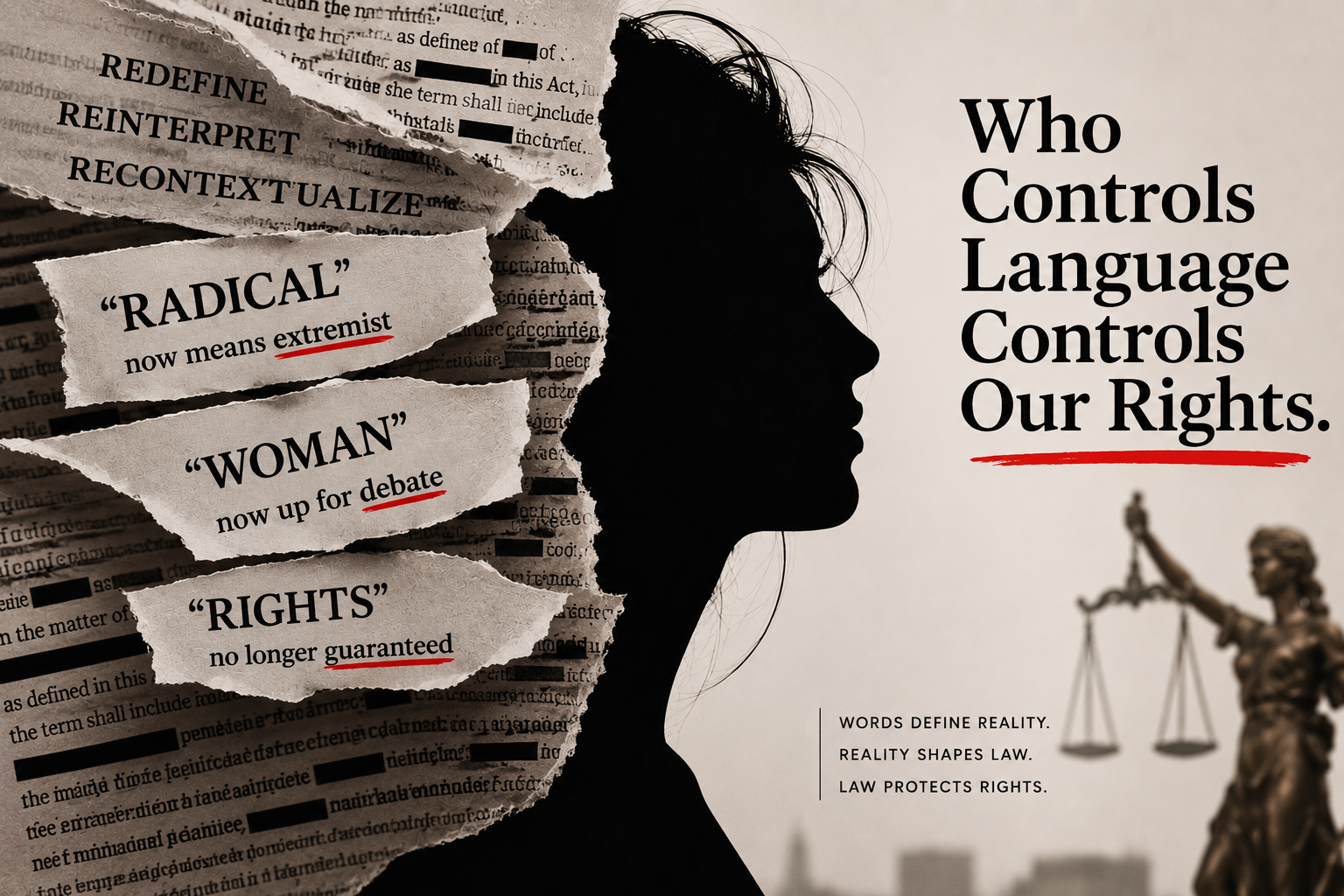
One of the first steps in changing a society is controlling its language and how people associate meaning with words. This is evident in legal battles, public policy, religious interpretation, school curricula, media narratives, social norms, and even in the fine print of contracts, products, and disclaimers.
Language is not merely a tool for communication; it is the framework through which we understand reality. Humanity has advanced throughout history as language has become more precise. Our ability to define, reason, persuade, and organize has transformed survival into civilization. Before laws are rewritten or institutions are restructured, language changes first.
Power may ultimately be enforced through war, violence, or coercion, but it begins with words. No movement can reshape a society without first persuading enough people to accept a new way of thinking. Every revolution begins by redefining language.
What we are witnessing today reflects two simultaneous realities. On one hand, there is a growing indifference toward the importance of words and their meanings. On the other, there is a deliberate effort to reshape language in ways that advance particular ideological and political goals and polices all dialogue. When definitions become unstable, reality itself becomes negotiable, and the public loses the ability to engage in honest discourse.
This is why reclaiming language matters.
Words have histories. They carry meaning that has developed over centuries. That does not mean language never evolves, but changes should bring greater clarity, not greater confusion. When words lose their shared meaning, they cease to unite people and instead become instruments of manipulation.
The word radical offers a useful example.
Today, many people immediately associate the word with extremism, violence, or dangerous political movements. That association is understandable because extremist groups have often adopted the label or have had it assigned to them. Yet this is not the original meaning of the word.
The word radical comes from the Latin radix, meaning root. To be radical, in its truest sense, is to go to the root of a problem. It is to examine the foundations, question assumptions, and address causes rather than symptoms. There is nothing inherently violent or extremist about radical thinking. Some of the greatest advances in science, medicine, philosophy, civil rights, and women's rights were radical precisely because they challenged deeply rooted injustice by returning to fundamental principles of truth and human dignity.
When extremist movements co-opt words, they distort public understanding. Entire concepts become tainted by associations that were never part of their original meaning. The result is that thoughtful people become reluctant to use accurate language, allowing those who manipulate words to control the conversation.
This is why reclaiming language is so important.
Reclaiming language is not about winning semantic debates or policing vocabulary. It is about restoring clarity. It means using words in ways that are understood, consistent, and reliable across educational backgrounds, cultures, and communities. Language should belong to everyone, not only to academic institutions, political movements, or cultural elites who redefine terms in ways that ordinary people neither recognize nor consent to.
When language becomes the exclusive domain of experts who continually redefine common words, power shifts away from the public. People begin making decisions based on narratives they cannot clearly identify because the very vocabulary they rely upon has changed beneath them. A society cannot meaningfully debate ideas when its citizens no longer share the same understanding of the words being used.
This reality has profound implications for women's rights.
We can begin with the most fundamental word of all: woman.
A woman is not an abstract philosophical concept, nor is she a subjective identity. The word refers to an observable human reality. Yet today, even defining the word has become controversial. What was once universally understood has become the subject of endless reinterpretation — most noticeably in the English language.
When the definition of woman becomes uncertain, the rights attached to that category inevitably become uncertain as well.
Women's rights were never secured for an abstract identity. They were established because of the lived reality of being female. Protections against sex discrimination, provisions for health, pregnancy and maternity, female-only spaces, women's sports, domestic violence services, rape crisis centers, institutions, and sex-based data all exist because women are a distinct class deserving equal protection under the law.
If the word woman no longer has a stable meaning, neither do the legal protections built upon it.
Language is therefore not a distraction from women's rights—it is the foundation of women's rights. We cannot defend what we are unwilling to define.
Reclaiming language is ultimately an act of democratic and civic responsibility. It preserves our ability to think clearly, communicate honestly, and hold institutions accountable. It allows people from every educational level, profession, and linguistic background to participate in public life without needing specialized ideological vocabulary to understand the issues that affect them.
Words matter because reality matters.
The fight for women's rights, like every struggle for justice, begins not only in legislatures or courtrooms but in language itself. In the way we refer to women. In words that describe her essence and experience. In how we speak about and to women.
History has shown that before rights are taken away, the language used to defend them is first rewritten. Every right begins with a word, every law with a definition, and every free society depends on the courage to defend truth before it has to defend freedom.