
Medical Misogyny: When Women’s Bodies Become Political Battlegrounds
By Jasmin Faulk, Executive Director
Medical misogyny refers to the systemic and historic bias against women in healthcare—the persistent pattern in which women’s pain, symptoms, and health concerns are dismissed, minimized, psychologized, and often treated as exaggerated or imagined. It occurs when a woman reporting physical distress or discomfort is told she is anxious, hormonal, overly emotional, or simply experiencing something “normal,” even when serious pathology is present. This behavior has been normalized outside of the medical field; women often hear similar statements from male partners, family members, or co-workers. While the term “medical misogyny” may feel contemporary, the problem is deeply historical and casually institutionalized. Women have spent centuries fighting for physical autonomy to be believed about their own bodies.
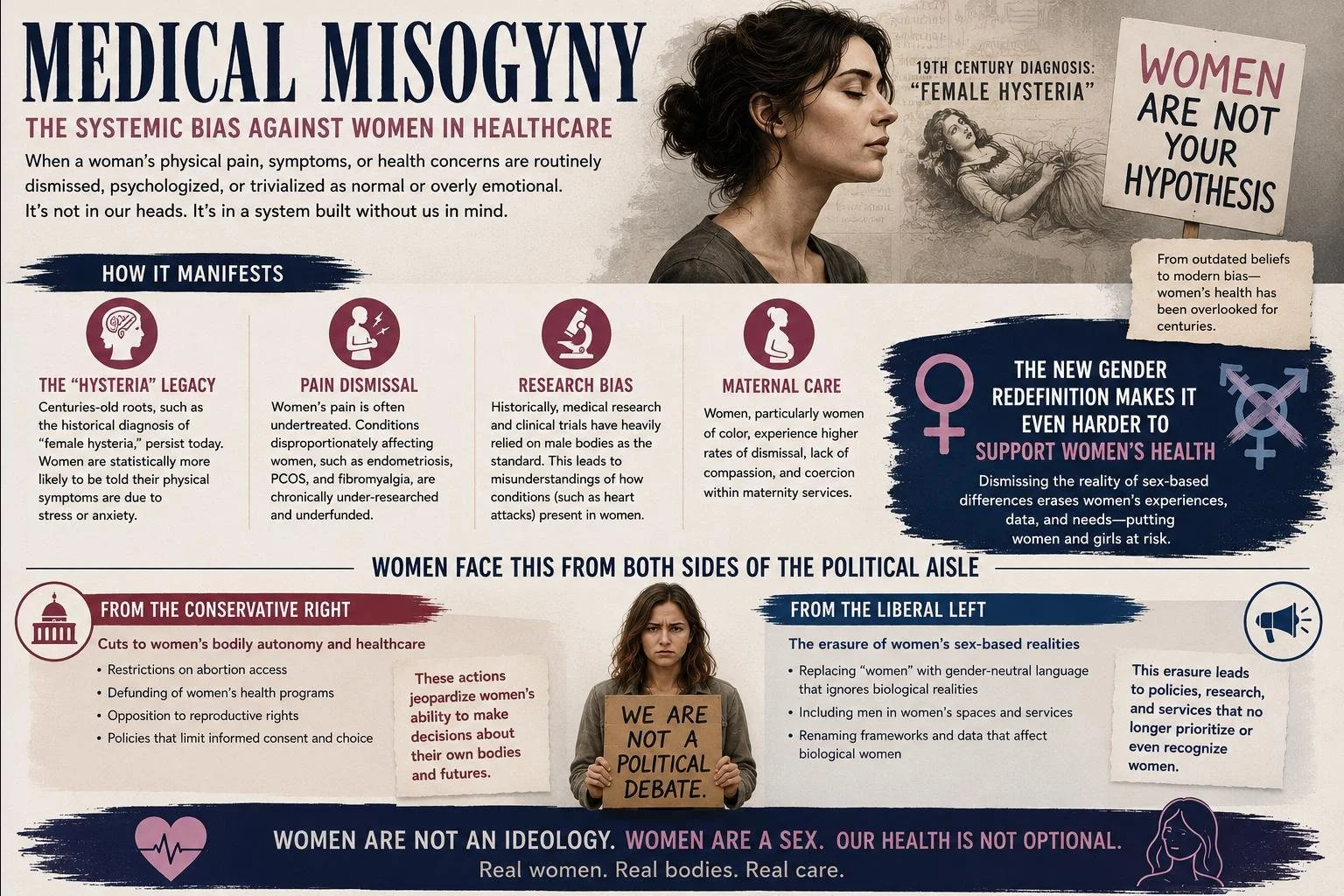
The roots of medical misogyny stretch back to the infamous diagnosis of female hysteria, a catch-all label used for centuries as a medical term, but dating back to ancient time as a way to diminish women’s bodies, symptoms, feelings, and experiences. The term female hysteria was used to explain away women’s pain, emotions, sexuality, and psychological distress. Under this framework, women were often viewed as unreliable narrators of their own physical experiences and unqualified to function and fully participate in society. That legacy did not disappear—it evolved and morphed into regressive tactics that reframe male dominance and patriarchal rule. Today, women remain statistically more likely than men to have physical symptoms attributed to stress, anxiety, or emotional instability, often delaying diagnosis and treatment, and persistently halting medical attention in prioritizing female health.
This bias is especially visible in pain management. Women’s pain is routinely under-treated, and conditions that disproportionately affect women remain chronically under-researched and underfunded. Disorders such as endometriosis, polycystic ovary syndrome (PCOS), and fibromyalgia frequently involve years of dismissal before diagnosis. The alarming statistic which shows that some female doctors are also less inclined to recognize these symptoms and acknowledge the realities of female patients is deeply disturbing. Many women can recount being told their severe pain was “just bad cramps,” their fatigue was “stress,” or their suffering was simply “part of womanhood”. The result is not just frustration—it is prolonged suffering, preventable complications, and reduced quality of life—it is a violation of human dignity.
Medical misogyny also appears in research itself. For decades, male bodies were treated as the default model in clinical research, with female physiology considered secondary or too hormonally complex to study. The inconsistency in research is evident in conventional medicine, exercise science, and mental health practices as well. This created serious gaps in medical knowledge. Even conditions that affect everyone, such as cardiovascular disease, may present differently in women. Heart attacks, for example, often manifest with symptoms that differ from the stereotypical male presentation, contributing to misdiagnosis, delayed care for women, and at times also tragic outcomes.
Maternal healthcare reveals another painful dimension of this problem. Pregnancy and childbirth—areas of medicine centered around female biology—remain spaces where women are often ignored, pressured, or coerced. Many women report having concerns dismissed during pregnancy, labor, and postpartum care. Pre-natal and post-natal care is often provided as a formula for medical practitioners to follow and for women to adhere to. These harms are even more severe for poor women, women of color, and in marginalized communities, who face significantly higher rates of maternal morbidity and mortality, alongside documented patterns of dismissal and reduced compassion from healthcare providers.
Yet as urgent as these longstanding issues are, the current cultural moment introduces a new challenge: the growing difficulty of speaking clearly about women’s health at all. To advocate effectively for women in medicine, we must be able to name the category we are discussing without confusion or exceptions. Women’s health is rooted in biological sex. Many of the conditions most impacted by medical misogyny—menstruation, pregnancy, menopause, ovarian disorders, reproductive cancers—are sex-based realities. When language becomes increasingly detached from biological sex, medical clarity suffers. This is not a social contagion, it is becoming a scientific reframe.
This is where the conversation becomes politically charged. On one side, conservative political movements continue to threaten women’s bodily autonomy through restrictions on reproductive healthcare, abortion access, and medical decision-making. These policies can limit women’s ability to make informed choices about their own bodies and futures. Curtailing autonomy has always been one of the clearest expressions of misogyny.
On the other side, progressive movements that seek to expand inclusion undermine women’s health advocacy by erasing sex-based language and realities. Replacing “women” with increasingly broad or clinical terminology can obscure who is actually affected by sex-specific health disparities; this terminology is not merely obscuring sex-based realities—it is also degrading to women. If we cannot speak plainly about female biology, it becomes harder to collect accurate data, identify disparities, conduct meaningful research, advocate for targeted care, and offer women the full dignity they deserve. The refusal to distinguish sex from perceived identity may satisfy radical ideological commitments, but it creates real harm and risks in medicine.
Women therefore find themselves squeezed from both extremes. From parts of the right, there is growing control over women’s healthcare choices and bodies. From parts of the left, there is increasing discomfort with naming female biological reality and accepting differences. Both trends, in similar ways, make women less visible. And invisibility in medicine is not only dangerous, it is life threatening.
This issue should not belong to any political tribe. A woman’s right to competent healthcare depends on being seen clearly, heard seriously, and treated according to reality rather than ideology or belief. Medical misogyny thrives wherever women’s bodies become symbols in larger political/social battles. The solution is neither regression nor erasure, it should not be bravery or a threat—it is honesty and reality.
Women deserve healthcare systems that believe them, research them, respect their autonomy, and acknowledge the reality of sex-based biology. Progress requires compassion, scientific rigor, and the courage to resist ideological distortions from all sides. Women’s health cannot be protected if women themselves disappear from the conversation or succumb to the pressure of being empathetic and inclusive to the very patriarchal-driven ideologies that have kept women under oppressive conditions in the first place.