
Coalition, conflict, and common purpose outside the Fever–Liberty game in Brooklyn
By Jasmin Faulk, Executive Director of Women’s Liberation Front
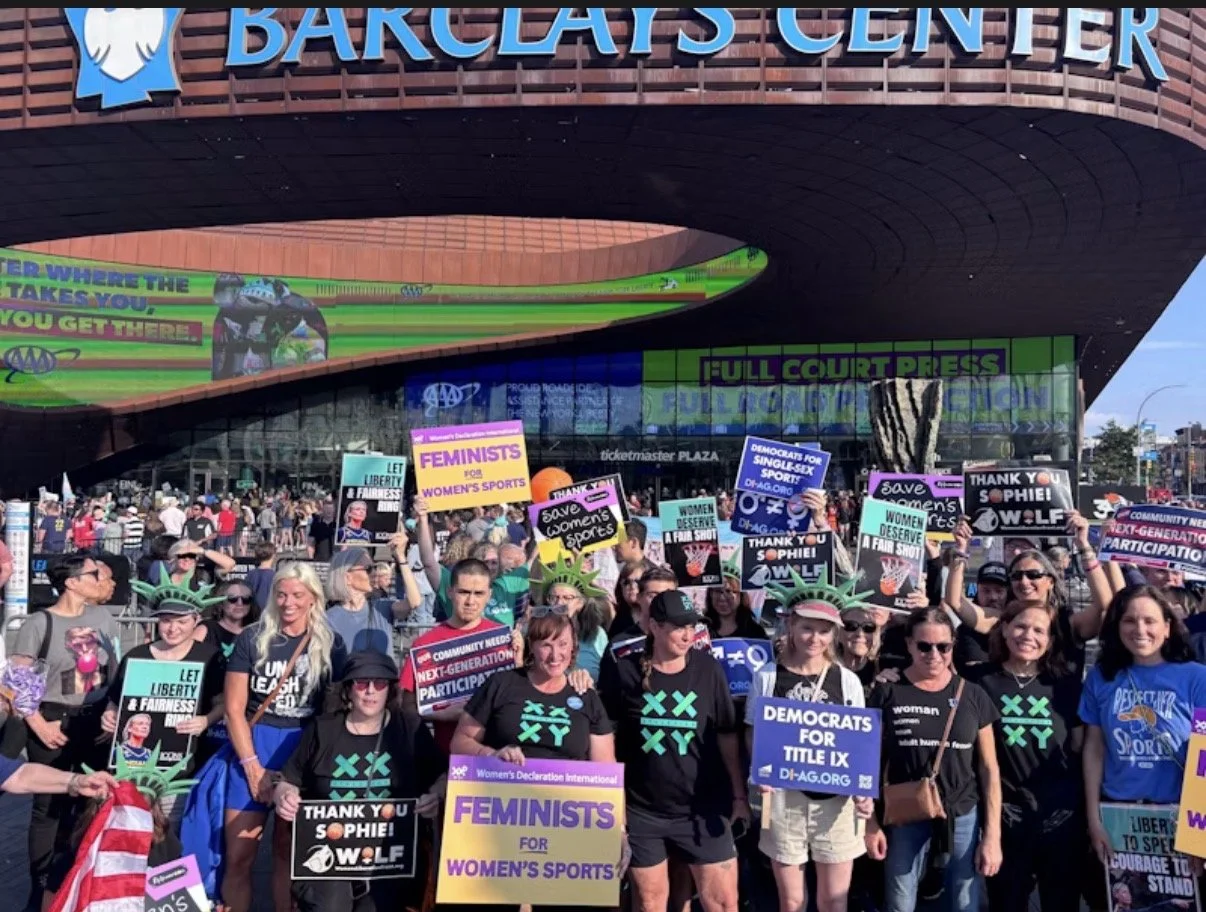
When I traveled to New York for the rally and the Indiana Fever–New York Liberty game, I expected to meet women and advocates who shared WoLF’s commitment to protecting women’s sports. What I experienced was much bigger than that.
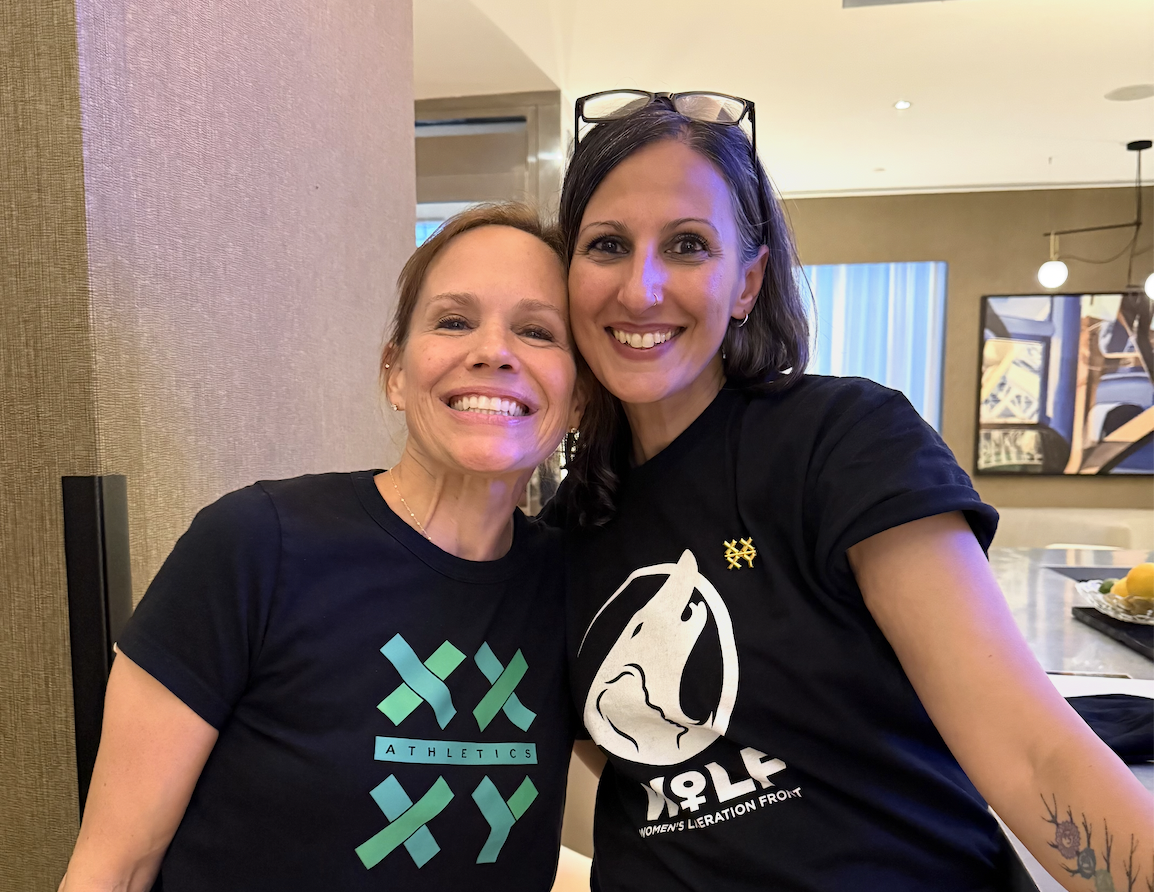
I saw the power of coalition building. I stood alongside people from Women’s Liberation Front, Democrats for an Informed Approach to Gender (DIAG), Women’s Declaration International (WDI), ICONS, ROAR, Maine Girl Dads, Amy Sousa, Jennifer Sey and XX-XY Athletics, and many others who have been showing up around the country in support of women and girls.
We came from very different political, social, and organizational backgrounds. There were feminists and conservatives, Democrats, Republicans, independents, lifelong activists, athletes, and people attending their first rally.
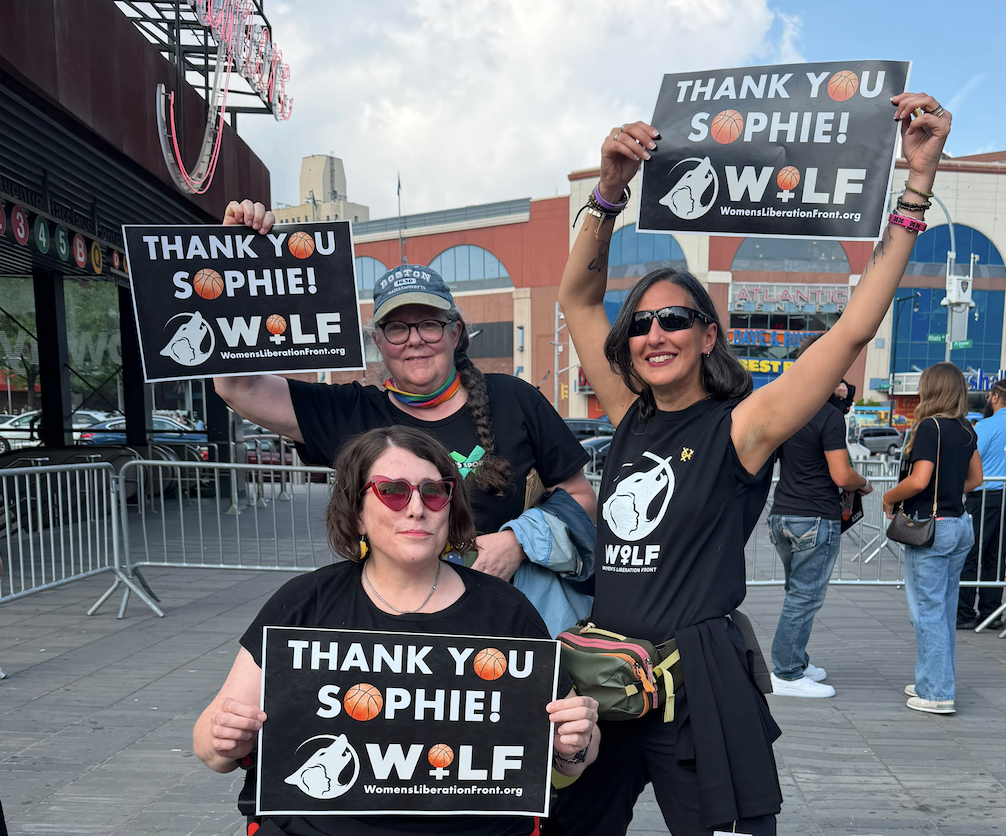
We were there for one clear purpose: to thank Sophie Cunningham for having the courage to speak up and to affirm that women and girls deserve fairness, dignity, and, most importantly, safety. That message belongs to no political party.
There was something deeply inspiring about sharing a space with people whose backgrounds and politics varied, yet whose voices were united around a solid, nonpartisan principle: women’s rights matter, women’s safety matters, and female sports must remain female.
Our rally was filled with joy, music, laughter, celebration, signs, and giveaways. Many of us had known one another only through social media, Zoom meetings, campaigns, or shared advocacy since we came from different parts of the country. Standing together in person made our growing movement feel real and visible.
Game attendees regularly stopped to express support for Sophie and for our message. Some told us that although they were Liberty fans, they stood with Sophie on this issue. It showed that supporting one’s favorite team does not require abandoning common sense. It is possible to love women’s basketball, cheer for the Liberty, and still believe that women’s sports must be protected.
Yet opponents repeatedly described our gathering as partisan, “far right,” conservative, and anti-trans. What I witnessed could not have been further from that portrayal.
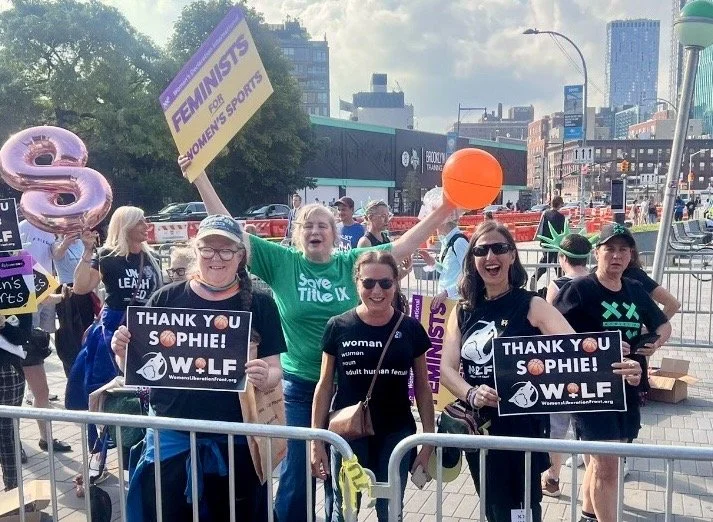
The coalition was politically diverse by any honest measure. Some participants came from feminist organizations. Others represented conservative groups. Some had long histories in progressive politics, while others came from very different traditions. We were united not by a political platform, but by the recognition that sex is real and that it matters when fairness and safety are at stake.
Reducing such a broad coalition to a partisan label of hate is a way of avoiding the substance of what we are saying.
The press moved between our gathering and a large pro-trans counter-rally nearby, giving reporters an opportunity to observe both sides directly.
I can speak only to what I personally saw and experienced. Our gathering remained peaceful, positive, and focused on women and girls. Across from us, some counter-demonstrators shouted and taunted our group. Individuals repeatedly attempted to enter or disrupt our gathering. Security personnel hired to protect our rally had to intervene several times, as did police officers who were present to keep both demonstrations safe.
Some demonstrators photographed and filmed us at close range and appeared to be trying to identify participants. At one point, two men approached me claiming to be on “our side.” They presented a petition based on a deliberately extreme distortion of our position, suggesting that everyone should be physically examined and tested to verify their sex. They then told me that because this was supposedly my position, I should sign the petition and provide my personal information. It was clearly not a sincere petition. We refused to sign it. When the men continued to insist, security asked them to leave.
The encounter was revealing. Instead of engaging with what we actually believe, they invented an absurd exaggerated position, attributed it to us, and tried to use that misrepresentation to collect identifying information.
Inside the arena
The game itself was exciting, energetic, and fun. It was wonderful to be surrounded by women’s basketball fans and to experience the atmosphere of a major WNBA game.
But we also heard significant booing whenever Sophie had the ball or scored. It was impossible not to recognize that at least some of the reaction was connected to her willingness to say publicly what so many women believe privately. Sophie has become a target because she voiced a common-sense position about fairness and safety in women’s sports. She has also become a symbol of the importance of speaking honestly, even when doing so brings hostility.
The events surrounding the game also raised questions about whether all women’s voices are truly welcome in women’s sports.
Julie Potter, a lesbian artist and longtime WNBA supporter who attended with our coalition, paid for a halftime scoreboard message thanking Jennifer Sey and XX-XY Athletics. According to reporting about the incident, the Liberty initially accepted the message and her payment, but later attempted to change its wording. When Potter objected and asked that her original message be displayed, the team refunded her payment.
Meanwhile, throughout the game, the Jumbotron displayed three different messages supporting and welcoming trans fans and the trans community more than eight times. We do not object the message that everyone is welcomed to attend the game. Everyone should be able to attend and enjoy women’s basketball. But the contrast was impossible to ignore: repeated messages supporting one community were prominently displayed, while a woman’s positive, paid message thanking Jennifer Sey and XX-XY Athletics was rejected and seen as potentially “not celebratory or positive”. The proposed message did not insult or threaten anyone. It expressed appreciation for a woman and a company dedicated to protecting female athletics.
If even a positive message of thanks is treated as too controversial for display at a WNBA (the W standing for Women) game, we should ask what that says about the boundaries being placed around women’s speech.
Women should not have to repeat approved language to participate in women’s sports. We should not have to hide our convictions, cover our clothing, abandon our signs, or remain silent about the importance of the female category.
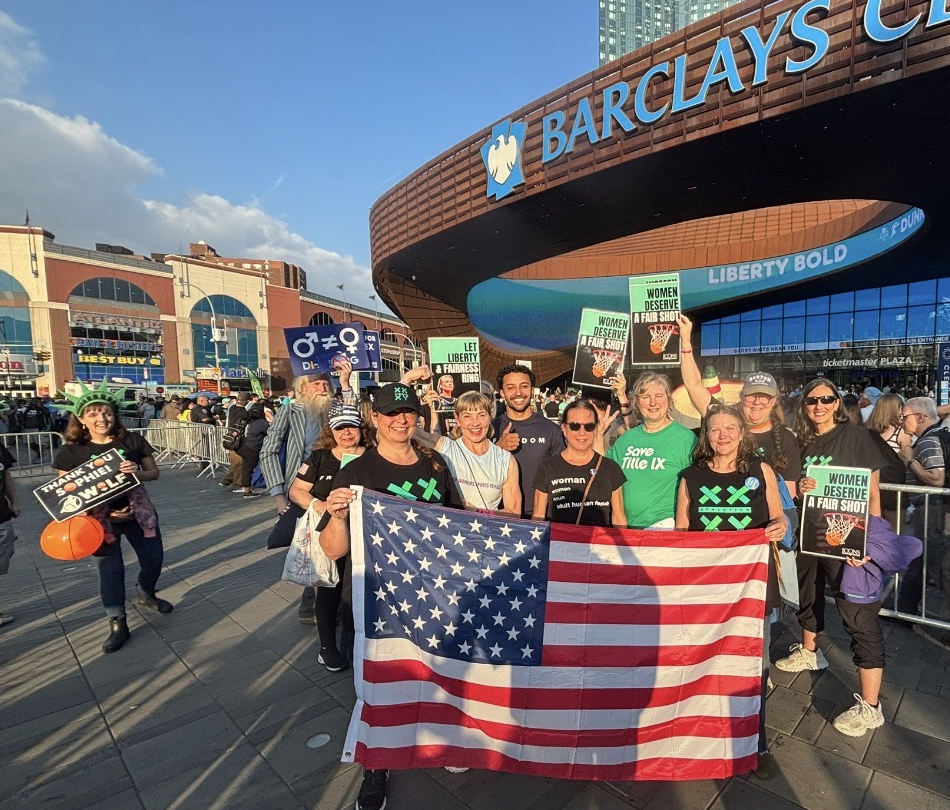
I left Brooklyn more convinced than ever that coalition building is not simply helpful to this work. It is essential. No single organization, political party, or group of activists can carry this movement alone. The effort to protect women’s rights is too important, and the consequences of silence are too serious. We must be willing to work with people who may not agree with us about everything but who are prepared to stand beside us where agreement matters. Coalition does not require ideological conformity. It requires maturity, courage, and the discipline to remain focused on a shared purpose.
We do not strengthen this movement by demanding that everyone pass a political purity test before they are permitted to defend women and girls. We strengthen it by building relationships, identifying common ground, and unifying our voices around clear principles. We proved this is possible.
WoLF will remain a non-partisan radical feminist organization committed to the liberation of women and girls. Other members of the coalition will continue to represent their own constituencies and perspectives. Unity does not equate sameness. It is the strength we need to recognize that protecting women and girls is bigger than any one of us.
Our position is pro-woman. It is not based on hatred of any person or group. Fairness is not hatred. Safety is not bigotry. Telling the truth about sex is not violence.
The attempt to characterize every defense of women’s rights as “anti-trans” is intended to make reasonable people afraid to speak. It also obscures the real issue: whether women and girls will retain the right to female-only sports, spaces, services, opportunities, and legal protections.
There is a particular power in showing up—in putting our names, signs, and voices behind what we believe. Online advocacy is important. Legal work, education, research, and lobbying are essential.
But there are moments when we must also stand together publicly and show women and girls that they are not alone.
I saw people from across political and social lines refusing to be divided. I saw women support women, and men support women. I saw fans demonstrate that love for women’s sports and the defense of female athletes belong together. I saw a coalition remain peaceful and focused despite provocation. And I saw how much stronger our voices become when we use them together.
This movement will continue to grow because its foundation is not partisan ideology. Its foundation is reality, fairness, safety, and the knowledge that women’s rights are worth defending.
Our message is simple and urgent:
Women and girls deserve fair play. Women and girls deserve safety. Women and girls deserve the freedom to speak without intimidation.
When feminists, conservatives, liberals, independents, athletes, advocates, parents, and ordinary citizens stand together, our differences do not weaken us. Our united purpose makes us stronger.